
Yuka... What is a good score?
We scan, we look at the rating... and sometimes we put the product straight back on the shelf.But what does a good score on Yuka actually mean?
Let's go back to basics!
Yuka is an app available on iOS and Android that helps you better understand the products you buy. It decodes food and cosmetic product labels by analysing their composition and potential impact on health.The app assigns a score out of 100 to help consumers make more informed choices in stores.The idea is simple:you scan, look at the score and decide whether or not to buy the item.Yuka is therefore a practical and quick tool that encourages more transparent and responsible consumption. But it's important to remember that Yuka is still a decision-making tool, the final choice is yours.
A score of 100 is excellent... but based on what elements?
The score out of 100 is based on three elements:
Nutritional quality (60%)
This is calculated using the Nutri-Score, developed as part of the National Nutrition and Health Programme.
This method assesses the nutritional balance of a product by taking into account:
- sugar
- salt
- saturated fats
- fibre
- protein
- calories
- fruit and vegetable content
The score is then converted into the Yuka rating system.
Additives (30%)
Additives (colourings, flavourings, etc.) also constitute an important part of the calculation, each additive is studied on the basis of available scientific data and classified according to its level of risk.
They are classified by risk level:
Green = no risk
Yellow = limited risk
Orange = moderate risk
Red = high risk
If an additive is considered high risk, the product's maximum score is automatically capped at 49/100.
The oganic label (10%)
A bonus is given to certified organic products (like Smile ;))
This recognition promotes products from organic farming and the absence of synthetic chemical pesticides.
How are the scores calculated?
Yuka then classifies products into four categories:
Excellent (75 to 100)
Good (50 to 74)
Mediocre (25 to 49)
Poor (0 to 24)
In concrete terms, a good score starts at 50/100.
Our Kombucha is rated 65/100!
Why are we rated 65/100?
Many people think that an organic product = an excellent Yuka score.
Even if it is organic and natural, Yuka mainly analyses the nutritional composition and ingredients.
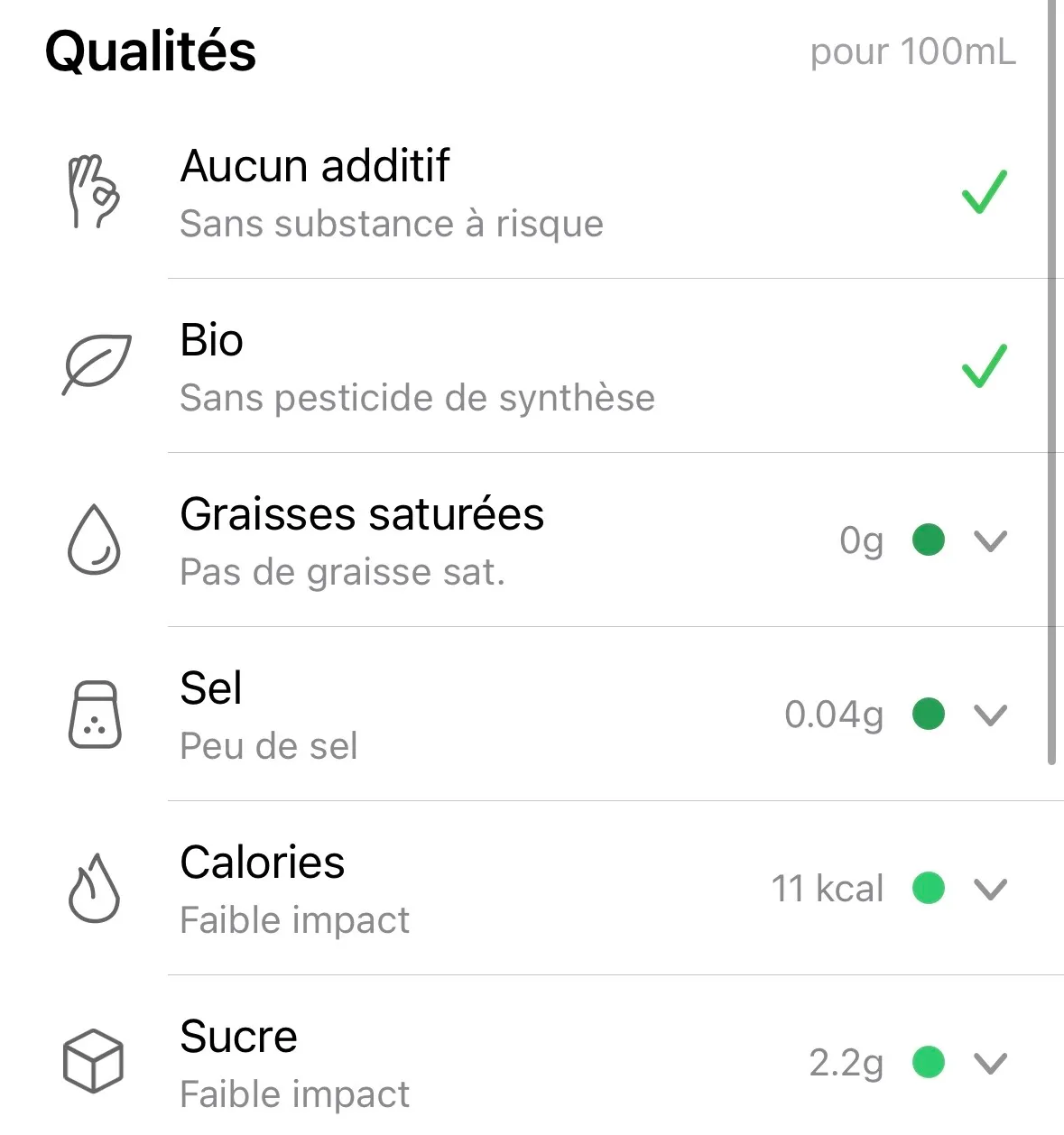
In the case of kombucha, sugar is essential to the fermentation process. It feeds the microorganisms that transform the base into kombucha, and some of it is consumed during fermentation, which explains our low final sugar content of 1.7g to 2.5g per 100ml.This is still low, but Yuka penalises the presence of sugar quite quickly, especially in drinks, and a few grams can be enough to lower the score.
But that doesn't mean it's bad for you. On the contrary, it proves that a product can be natural, balanced and high-quality even without achieving the maximum score ;)
Our « Brut » rated on Yuka:
What the score does not always take into account
Yuka mainly analyses composition and nutrients.
However, certain elements such as the manufacturing process, fermentation or the quality of the ingredients added to our raw base are not always fully reflected in the score.
So yes, Yuka helps us consume better. And by consuming better, we take better care of ourselves, and of the world around us. Yuka does something rare: it makes transparency easy. And easy transparency means better choices, for you and for the planet. Transparency, by the way, is one of Smile's core values. Just like our bottles: you can see right through them.
Disclaimer:
This article is for informational purposes only. Yuka's scoring methodology is their own and may evolve over time. Our score reflects our product as currently listed on their platform. A number is a starting point, not a verdict. Read the label, trust your gut, and if in doubt, ask us.
Sources:
- Yuka, 2026, https://yuka.io
- Produits alimentaires, Yuka, 2026, https://help.yuka.io/l/fr/article/ijzgfvi1jq-notation-produits-alimentaires
