
Why we chose organic?
It may seem obvious, we produce a drink that has health benefits, so making it non-organic wouldn’t make any sense. But it goes much further than that, our choice is not based solely on product consistency, it’s part of a broader reflection on the impact we want to have, on the agricultural model we want to support, and on the world we want to contribute to.
By choosing organic, Smile is part of a transition toward a better world that makes sense. It’s one of our ways to participate in sustainable development and to help limit soil, air, and water pollution.
But what is the definition of “organic” concretely?
It’s a farming production method that focuses on life by excluding synthetic pesticides, chemical herbicides, and artificial fertilizers, placing respect for the environment and biodiversity at the heart of its priorities.
The way it is experienced:
- In the field and in livestock farming: It promotes ecological balance through crop rotation, recycling organic matter, and the animals’ food autonomy.²
- In processing: Organic strictly regulates technological processes and strongly limits the number of authorized additives in order to preserve product quality and protect human health.²
- Direct protection: One of the major benefits of organic is the absence of synthetic pesticides, so groundwater is better preserved, biodiversity in the fields is richer, and farmers and nearby residents are less exposed to toxic substances.²
- 30% more biodiversity: It’s a virtuous circle, by avoiding chemicals, organic helps protect ecosystems, regenerate soils, and restore natural balances. Organic fields also host on average one third more biodiversity.²
Is there a label?
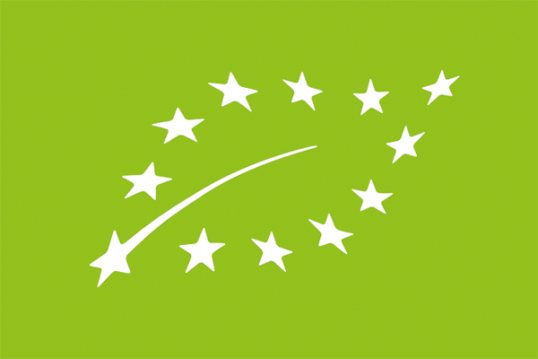
Yes, since 2010 the label has been mandatory on all pre-packaged European organic food products.
What does it look like?
It’s a small green leaf drawn with white stars. It is the official European logo.
Here it is:
Another important point…
BE-BIO-01 is the official code appearing on certified organic products in Belgium. It indicates that the product has been certified by CERTISYS, an approved body that verifies compliance with European organic farming rules⁵.
The principle is simple:the code always begins with the country, followed by the certifying body's identifier.
It therefore varies depending on the place of manufacture:
- FR-BIO-01 for France via Ecocert
- DE-ÖKO-003 for Germany via LACON
- NL-BIO-01 for the Netherlands via SKAL
It may be a small, discreet code, but behind it lies a whole system of controls, audits and traceability.
What does it guarantee?
What the label concretely guarantees:
- Full compliance with European ecological standards.⁴
- Regular inspections of all operators in the chain.⁴
- At least 95% organic ingredients for processed products (the remaining 5% being strictly regulated).⁴
They therefore must comply with the same standards, and all organic products are checked and certified.
From principle to practice!
Our commitment is reflected in each of our ingredients…
The tea (the base): We use a blend of certified organic black and green tea leaves, which means they have grown without pesticides, drawing all their antioxidant power from healthy soils.
Cane sugar: Also organic, and it is the preferred fuel of our SCOBY (our kombucha “mother”). Since it is raw and unrefined, it provides the nutrients needed for slow and natural fermentation.
The “extras”: Verbena, ginger, hibiscus, lemon…
Each ingredient added to our “Brut” base is chosen for its quality. We work only with fruit purées, juices, infusions, or macerations.
No concentrates, no flavors, no powders… Only real, only natural.
Some facts…
50% more vitamin C: that’s what we often find in organic plant-based foods, meaning more antioxidants for a sparkling organism.²
50% fewer nitrates: therefore fewer residues in leaves and roots, more room for purity.²
70% more omega-3: even in lipids, organic makes a difference with more polyunsaturated fatty acids.²
Organic plant-based foods contain more dry matter (less water) and often more minerals, such as magnesium.²
In short,
Take care of your mothers, because they take care of you in return.
When we feed our mother culture organic ingredients, we give her the best possible environment to ferment. She gives it back by creating a drink naturally rich in organic acids and beneficial bacteria.
At Smile, organic is not a marketing choice. It is our direction. It is part of our values and commitments, and it is non-negotiable. By supporting agriculture that respects the soil and protects biodiversity, we help ensure that future generations can also raise a glass to the health of the planet.
Disclaimer:
This article is for informational purposes only. The figures cited come from published studies and institutional sources, all linked above. Organic certification rules may evolve over time. For the most current regulatory information, CERTISYS and the European Commission remain the authoritative references. We grow neither tea nor sugar ourselves, but we choose our suppliers carefully.
Sources:
- Agence BIO. - Qu’est-ce que l’agriculture biologique ?https://www.agencebio.org/decouvrir-le-bio/quest-ce-que-lagriculture-biologique/
- Basta!. (2022) - Alimentation bio et santé : ce que dit la science. https://basta.media/alimentation-bio-et-sante-ce-que-dit-la-science
- Label Energie. - Manger bio a-t-il un impact positif sur la planète ? https://labellenergie.fr/manger-bio-a-t-il-un-impact-positif-sur-la-planete/
- Bio Mon Choix. (2018) - Biologique Eurofeuille : certification. https://biomonchoix.be/2018-848-biologique-eurofeuille-certification/
- Tout savoir sur le règlement bio - Certisys https://www.certisys.eu/fr/
